In a high-volume commercial bakery or restaurant kitchen, every second and every square inch of workspace matters. When production lines are churning out hundreds of loaves of bread, delicate pastries, cookies, or sheet cakes daily, the choice of bakeware material is far more than a minor preference—it is a core driver of operational efficiency, energy consumption, and labor costs.
Among professional bakers, two materials dominate the landscape: natural aluminum and non-stick coated bakeware (typically aluminum or aluminized steel with a PTFE or silicone glaze). Each material behaves fundamentally differently in terms of heat transfer, durability, cleaning time, and product release.
Understanding how these differences impact your kitchen’s daily workflow helps you make informed purchasing decisions that maximize both throughput and profit margins.
1. Understanding Natural Aluminum Bakeware
Natural aluminum sheet pans and cake molds are the undisputed traditional workhorses of commercial kitchens. Crafted from commercial-grade aluminum alloys (such as 3003 or 1100 series), these pans are prized for their raw, unadorned metallic properties.
Key Characteristics of Natural Aluminum:
-
Superior Thermal Conductivity: Aluminum is an exceptional heat conductor. It absorbs and distributes heat evenly across the entire surface much faster than stainless steel or cast iron.
-
Lightweight and Rigid: Heavy-gauge natural aluminum pans are lightweight yet sturdy, preventing hand fatigue for kitchen staff while resisting heavy warp under standard thermal cycles.
-
No Chemical Coatings: Because there is no outer coating to degrade, natural aluminum can withstand aggressive scrubbing, metal utensils, and high-heat sanitization without risk of flaking.
Operational Advantages:
-
Rapid Cooling Cycles: Natural aluminum cools down quickly once removed from the oven, preventing residual heat from over-baking delicate items like cookies or sponge cakes.
-
Long-Term Durability: A quality natural aluminum sheet pan can last for years, enduring thousands of cycles if properly maintained.
Operational Disadvantages:
-
Requires Release Agents: Because the surface is porous at a microscopic level, food will stick without the application of oil, butter, pan sprays, or parchment paper.
-
Parchment Dependency: High-volume bakeries often rely heavily on parchment paper liners with natural aluminum pans to ensure easy product release, adding to consumable supply costs.
2. Understanding Non-Stick Coated Bakeware
Non-stick bakeware applies advanced polymer coatings (such as PTFE, silicone-infused layers, or ceramic-reinforced matrices) over an aluminum or aluminized steel base. These pans are designed to streamline operations by eliminating the need for extra fats or paper liners.
Key Characteristics of Non-Stick Bakeware:
-
Low Surface Energy: The specialized coating creates a hydrophobic and oleophobic barrier where baked goods slide off effortlessly.
-
Aluminized Steel Base: Many commercial non-stick pans utilize an aluminized steel core, combining the strength and rigidity of steel with the heat distribution of aluminum.
Operational Advantages:
-
Lightning-Fast Product Release: Baked goods pop out cleanly and instantly, drastically reducing handling time during packaging and cooling.
-
Savings on Consumables: By eliminating or drastically reducing the need for parchment paper, non-stick spray, and butter greasing, kitchens save significantly on ongoing supply expenses.
-
Aesthetic Consistency: Non-stick pans prevent delicate items like sticky buns, muffins, and delicate tarts from tearing, reducing product waste and visual defects.
Operational Disadvantages:
-
Sensitivity to High Heat: Excessive oven temperatures (typically above $450^\circ\text{F}$ or $232^\circ\text{C}$) can degrade non-stick coatings prematurely, causing them to blister or peel.
-
Strict Utensil Limitations: Metal spatulas, knives, or scouring pads ruin non-stick surfaces instantly, requiring staff training and specialized nylon or silicone tools.
-
Shorter Lifespan: Even heavy-duty commercial non-stick coatings eventually wear down, requiring periodic fleet replacement.
3. Direct Impact on Baking Efficiency and Workflow
To see how these choices affect a high-volume operation, let’s examine four core pillars of kitchen efficiency:
[ Thermal Performance ] ➔ [ Labor & Prep Speed ] ➔ [ Warewashing & Cleanup ] ➔ [ Consumable Expenses ]
A. Thermal Performance and Bake Times
-
Natural Aluminum: Reflects radiant heat slightly more than dark non-stick surfaces, resulting in lighter-colored crusts on bread and even, golden-brown cookies. Heat transfer is exceptionally fast, reducing overall bake times.
-
Non-Stick Coatings: Darker non-stick finishes absorb heat faster, which can slightly accelerate browning times. Bakers must often adjust oven temperatures down by $25^\circ\text{F}$ ($10\text{–}15^\circ\text{C}$) or shorten bake times to prevent over-browning.
B. Labor and Prep Speed
-
Natural Aluminum: Prep stations must spend extra time greasing pans or laying down custom-cut parchment paper sheets before baking.
-
Non-Stick: Pans go straight from storage to the depositor or mixer, saving precious seconds per batch that accumulate into hours of saved labor during peak holiday rushes.
C. Warewashing and Cleanup Protocols
-
Natural Aluminum: Can handle aggressive commercial dishwasher detergents, high-pressure sprayers, and occasional scrubbing with abrasive pads to remove baked-on carbon.
-
Non-Stick: Requires gentle hand washing or delicate cycle treatment. Scrubbing with steel wool destroys the pan, meaning dishwashers must handle them with care, slowing down dish pit throughput.
4. Quick Comparison Matrix
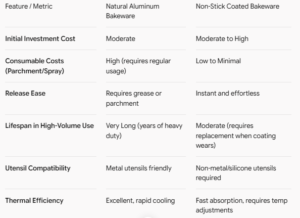
5. Which One Should Your Kitchen Choose?
There is rarely a single “correct” choice for an entire commercial kitchen; many high-volume operations utilize a hybrid strategy:
-
Choose Natural Aluminum For: General-purpose cookie baking, roasting vegetables, sheet cakes, and high-volume daily tasks where pans undergo heavy mechanical washing and metal utensil contact. Pair them with bulk parchment paper sheets for quick turnaround.
-
Choose Non-Stick Bakeware For: Specialty items prone to sticking, such as sticky buns, high-sugar muffin batters, pound cakes, and delicate molded pastries where appearance and clean release are paramount.